

Why the DISC Framework Improves Communication
People don’t come with instruction manuals, yet daily work demands fast, empathetic collaboration. The DISC framework gives individuals and teams a practical language to describe observable behaviors, reduce misunderstandings, and accelerate trust. Instead of pathologizing personality, it emphasizes what others can see and hear in real interactions: pace, priority, and preferred ways of engaging under pressure. That makes it uniquely useful for managers, coaches, and teammates who need actionable clarity rather than abstract theory.

Behind the colorful graphs and style labels, the DISC assessment meaning lives in its practical power to describe observable behavior without pathologizing people. In practice, the framework helps you answer questions like: How do I like to make decisions? When do I lean into details versus big-picture momentum? How do I prefer to be approached in conflict? These insights lower friction because they are grounded in day-to-day patterns instead of fixed labels. When teams adopt a shared vocabulary, they can shift from blame to curiosity, tailoring communication to fit the moment instead of forcing one style to rule all.
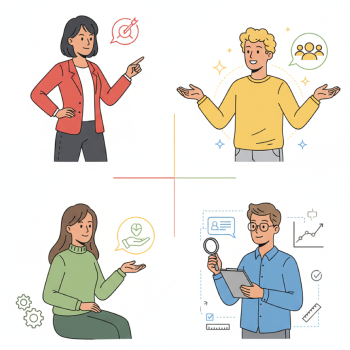
Rooted in Marston’s theory of emotions, the DISC model frames behavior along pace and priority so practitioners can translate patterns into action. On one axis you’ll find fast versus measured tempo; on the other, people focus versus task focus. Crossing the axes yields four primary style clusters that describe common tendencies without boxing anyone in. Think of it as a map of likely routes, not a cage that restricts movement, where individuals can flex based on context and skill.
Start the TestTangible Benefits for People, Teams, and Organizations
To prioritize effort, teams often start with a sharp DISC analysis that highlights friction points and shared strengths across functions. With a concise map of tendencies, leaders can build agreements about how decisions get made, how feedback is offered, and how conflict will be handled before pressure spikes. That foresight prevents avoidable escalations and fosters psychological safety by making expectations explicit rather than assumed.

When job demands shift, leaders can align expectations with a focused DISC workplace profile that clarifies situational behaviors needed to excel. Hiring managers can tailor interviews to surface the right evidence, L&D can design targeted practice labs, and peers can give feedback that lands, because it speaks directly to observable behaviors. The ripple effect is measurable: faster ramp times, clearer handoffs, and a culture where people flex on purpose, not by accident.
-
![]() Onboarding playbooks that outline how to communicate with each teammate during the first 90 days.
Onboarding playbooks that outline how to communicate with each teammate during the first 90 days. -
![]() Meeting design that balances exploration and evaluation to prevent either chaos or paralysis.
Meeting design that balances exploration and evaluation to prevent either chaos or paralysis. -
![]() Sales and service scripts tuned to client pace, priorities, and decision styles.
Sales and service scripts tuned to client pace, priorities, and decision styles.

The Four Primary Styles at a Glance
The four core styles, often summarized as D, I, S, and C, are best understood as a spectrum rather than boxes. Each style brings assets and blind spots, and the magic happens when teams blend them intentionally. The goal is not to “become” a different letter, but to flex skillfully: push when needed, pause when wise, and adapt communication to what the moment demands. A quick reference grid can help you translate tendencies into practical moves.
| Style | Core Drive | Strengths | Watchouts | Communication Tips |
|---|---|---|---|---|
| D, Direct | Results and speed | Decisive, bold, future-focused | Impatience, bluntness, risk of steamrolling | Be brief, lead with outcomes, offer options |
| I, Interactive | Connection and enthusiasm | Persuasive, energetic, optimistic | Overpromising, low follow-through, distraction | Start warm, co-create, summarize commitments |
| S, Steady | Harmony and support | Patient, team-first, dependable | Reluctance to change, conflict avoidance | Provide context, allow time, invite questions |
| C, Conscientious | Accuracy and standards | Analytical, careful, quality-driven | Overanalysis, rigidity, perfectionism | Share data, outline risks, define criteria |
Rather than boxing people in, a nuanced DISC personality snapshot simply spotlights preferred behaviors under typical pressure. Coaches often use scenario-based practice to help people experiment with new micro-behaviors, such as shortening a status update, adding a clarifying question, or offering a decision path. Over time, small moves compound into big outcomes: fewer misunderstandings, cleaner decisions, and stronger follow-through. For deeper coaching, a rigorous DISC personality assessment connects day‑to‑day interactions to underlying drives that can be coached ethically. Practitioners pair structured feedback with measurable experiments, such as time-boxed analysis before proposing options, or pre-meeting briefs that align expectations. The emphasis stays on behavior you can practice, not on labels you must wear, ensuring growth remains both humane and effective.
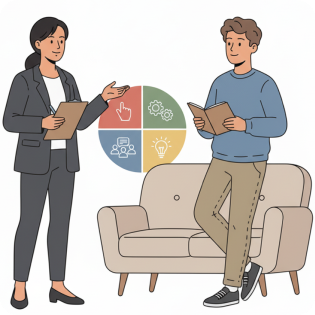
Making DISC Training Stick
To turn insights into outcomes, treat rollout like a change initiative rather than a one-off workshop. Beyond a one‑off workshop, effective programs invest in applied DISC training that turns insights into repeatable habits through practice. Build momentum with leaders first, equip managers as coaches, and reinforce through nudges, checklists, templates, and shared rituals that normalize the language.
Start the Test-
![]() Define clear goals and success metrics tied to communication, decision speed, and quality.
Define clear goals and success metrics tied to communication, decision speed, and quality. -
![]() Pilot with a cross-functional team to gather feedback and refine facilitation.
Pilot with a cross-functional team to gather feedback and refine facilitation. -
![]() Create playbooks for meetings, feedback, and conflict that use shared terms.
Create playbooks for meetings, feedback, and conflict that use shared terms.
Keeping DISC Skills Fresh
Sustainability comes from weaving practice into the flow of work, retrospectives, one-on-ones, and project kickoffs, so the language sticks. To maintain rigor, many organizations standardize timing and instructions for any DISC assessment test to reduce noise and bias. Pair that with facilitator training, ethical data policies, and a cadence of refreshers to keep skills sharp as roles evolve and teams change.
Start the Test
Online DISC Personality Test With Profile Assessment
Get StartedLeadership, Culture, and Strategic Communication
Culture amplifies or dampens the value of behavioral insight, which means leaders set the tone for how the language is used. For executives navigating culture, a targeted DISC leadership assessment reveals how decision speed, risk posture, and messaging land with different audiences. When leaders model flexing, slowing down for diligence, speeding up to seize windows, or switching from email to live dialogue, others follow suit.
Coaching that sticks connects style awareness to concrete leadership behaviors: prioritization, stakeholder mapping, escalation rules, and feedback hygiene. For continuity across roles, a calibrated DISC personality profile helps mentors reference the same language while measuring growth over time. Over quarters, this creates institutional muscle memory: a way of working that is both human-centered and execution-minded, where candor and care reinforce each other instead of competing.

Choosing the Right Tool and Taking Your First Step
Not all instruments are created equal, and context matters. For learners exploring options, some publishers offer a starter‑level DISC personality test free so people can sample the method before enrolling. Evaluate the experience quality, coaching support, and data stewardship, not just the aesthetics of the report.
Budget and scale often shape your rollout plan as much as methodology. For pilots on a tight budget, nonprofits sometimes host a limited DISC assessment free to seed awareness in community programs. If you need enterprise-wide reliability, look for validated instruments, trained facilitators, and playbooks that integrate with existing rhythms.
Implementation should account for fairness, accessibility, and change management from the start. For compliance and fairness, HR should confirm whether the chosen DISC test meets legal and ethical guidelines in each jurisdiction. Align the initiative with concrete business outcomes, customer satisfaction, cycle time, or quality, so leaders can see and celebrate progress.
FAQ: Common Questions About the Method
- What is DISC in simple terms?Think of it as a practical map of behavioral tendencies that shows how people prefer to move, decide, and communicate. Beyond the report itself, a well‑run DISC assessment becomes a shared language that reduces guesswork in daily collaboration. The focus stays on visible behavior you can practice, which keeps growth specific, measurable, and respectful.
- Is this approach scientifically sound?Reputable publishers invest in psychometric research, ongoing norm samples, and rigorous validation to protect quality. The most useful results come when instruments are paired with observation, coaching, and clearly defined behavioral experiments that tie to outcomes.
- Can it help with hiring and onboarding?It can inform structured interviews, team fit conversations, and onboarding plans when used ethically and transparently. The key is role clarity: define the behaviors that drive success first, then use insights to tailor development and support without stereotyping candidates.
- How long does it take to see results?Teams often feel immediate relief as conversations become clearer and meetings tighten up. Measurable gains in trust, speed, and quality usually compound over several cycles of practice, reflection, and adjustment.
- What’s the difference between styles and profiles?Styles describe clusters of tendencies along pace and priority, while profiles summarize a person’s observed pattern at a point in time. In day‑to‑day use, a concise DISC profile gives colleagues a quick way to anticipate preferences without stereotyping. Remember that context matters, so flexing across situations is a sign of maturity, not inconsistency.
The Latest News
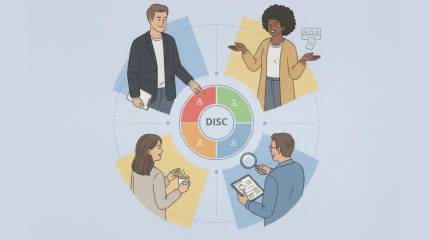 DISC Test: A Practical Lens for Behavior and Communication Online DISC Personality Test With Profile Assessment Get Started Understanding the DISC Test: Foundations, Science, and Scope Human effectiveness improves dramatically when we can decode how people prefer to communicate, decide, and collaborate. In modern organizations and personal...
 - 27 December, 2025
- The Definitive Guide to DISC Profile Test: Understand Behavior and Communicate Better Online DISC Personality Test With Profile Assessment Get Started Understanding the DISC Test and Its Real Value People accelerate trust and collaboration when they understand how preferences, pace, and priorities shape their interactions. The model commonly called DISC simplifies co...
- 26 December, 2025
- The Complete Guide to the DISC Personality Model for Clearer Communication Online DISC Personality Test With Profile Assessment Get Started What the DISC Model Is and Why It Matters Modern organizations need a common language to talk about work styles, conflict preferences, and collaboration patterns. The DISC framework offers a simple yet powerful way to...
- 25 December, 2025
Please Note
This website (discassessmentonline.net) is not an official representative, creator or developer of this application, game, or product. All the copyrighted materials belong to their respective owners. All the content on this website is used for educational and informative purposes only.